 Search


Breastfeeding is a skill that can take time and practice to learn. The key to successful breastfeeding is good attachment (when all your nipple is in their mouth).
If your baby is attached properly to your breast, they will get more milk and feeding will feel more comfortable. Good attachment also helps prevent sore and cracked nipples.
Some people might use the word latch instead of attach.
Tips for good attachment:
- Make sure you are comfortable and relaxed.
- Hold your baby in your arms so they are facing your chest.
- Support their upper back and shoulders so they can move their head and neck freely.
- Move your baby towards your breast (not your breast towards the baby).
- Touch your baby’s lips with your nipple to encourage your baby to open their mouth wide.
- When your baby's mouth is very wide (like yawning), bring your baby to the breast quickly.
- Get as much of the areola (the dark area around your nipple) in your baby’s mouth as possible.
- Baby’s chin should be touching your breast.
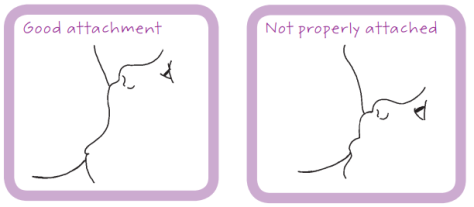
Image: NSW Health Having a Baby p.95
Baby-led attachment (when a baby finds their mother's breast on their own).
Baby-led attachment is usually used in the first few hours after you have given birth.
When babies are placed skin to skin on their mother's breast and are ready to feed, they can usually find the breast by using their sense of smell and touch (rooting reflex).
The rooting reflex makes your baby search and open their mouth wide when their cheek or chin rubs your breast.
Signs your baby is feeding well:
- Little or no nipple pain. If you feel any pain, try stopping and reattaching.
- At first, your baby will take fast sucks – these will then slow down.
- Takes short pauses/breaks but continues to suck again without you having to do anything.
- You can hear a suck, swallow or gulping sound after a minute or two.
- Cheeks look full and they have a good mouthful of breast.
- Baby’s chin is pressed against your breast.
- They seem calm and relaxed during feeds.
- Nipple has a normal shape when your baby comes off.
Breastfeeding attachment video
More breastfeeding resources
- The Raising Children Network breastfeeding videos are a good guide to positioning your baby and helping them develop a good latch on the breast.
- These pictures may help you with attachment.
- Read the Breastfeeding Your Baby booklet by NSW Health
- Find out more about breastfeeding twins or more than two babies.
Videos
- Watch this video on the many different positions you can use to breastfeed.
- Watch a baby finding the breast, attaching and starting to feed.
- Watch this video on getting a good attachment
Talk to a health professional if you find breastfeeding challenging.